
Carpenter Ants vs Regular Ants: Identifying the Real Threat to Your Home
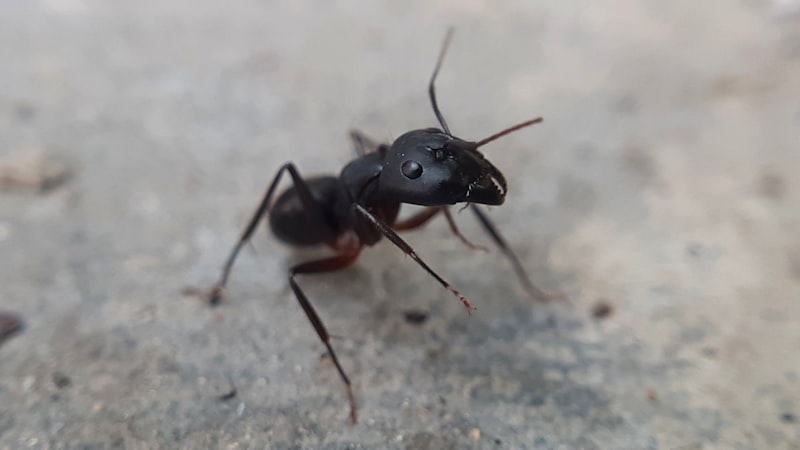
Finding ants marching across your kitchen counter is annoying. Finding carpenter ants tunnelling through the structural beams of your house is a completely different problem. In Quebec, both scenarios are common, and knowing which ant you are dealing with determines whether you need a quick cleanup or an urgent call to an exterminator.
Size and Appearance
The easiest way to tell them apart is size. Carpenter ants (Camponotus species) are among the largest ants in Canada, measuring 6 to 25 mm. They are usually black or dark brown, sometimes with a reddish-brown thorax. Their bodies have a smooth, rounded profile between the thorax and abdomen.
Common pavement ants and little black ants — the species you typically see on sidewalks and kitchen floors — rarely exceed 4 mm. They are uniformly dark and have a more segmented look with visible spines on the thorax under magnification.
Behaviour and Habitat
Regular ants nest outdoors in soil, under pavers, or along foundation edges. They enter homes to forage for crumbs and sugary spills but usually return to their outdoor colony.
Carpenter ants, on the other hand, establish satellite colonies inside your walls, especially in wood that has been softened by moisture. They do not eat wood the way termites do — instead, they excavate it to create smooth galleries for nesting. You may notice fine sawdust-like shavings (called frass) near baseboards, window frames, or in the basement.
The Damage Difference
Regular ants cause no structural damage. Carpenter ants can compromise load-bearing wood over time. In older Montreal-area homes with rubble-stone foundations or wood-frame additions, the risk is especially high because moisture often accumulates in these structures, creating ideal conditions for carpenter ant colonies.
Signs of carpenter ant damage include hollow-sounding wood when tapped, small slit-like openings in wooden surfaces, and piles of frass on the floor below affected areas.
Seasonal Clues in Quebec
If you see large winged ants inside your home between April and June, you are almost certainly looking at carpenter ant swarmers — reproductive ants leaving the colony to start new ones. This is a strong indicator of a mature colony that has been growing inside your walls for at least two years.
Regular ant swarms also happen in spring but tend to occur outdoors near sidewalks and driveways.
Treatment Approach
For regular ants, eliminating food sources and sealing entry points is usually enough. Bait traps from a hardware store can handle small invasions.
Carpenter ants require professional treatment. An exterminator will locate the main colony — often by following ant trails at night when workers are most active — and apply targeted treatments directly into wall voids and nesting areas. At Extermination DMP, we also identify and recommend repairs for the moisture source that attracted the colony in the first place, preventing future re-infestation.
Confirmed it's carpenter ants?
See our full carpenter ant inspection and colony treatment service — what we look for, how we treat the queen (not just the workers), and what to expect during the visit. Same-day service in Montreal and the South Shore.
See Carpenter Ant Service Details →Got a pest problem now?
Same-day response on emergencies. Local Saint-Hubert team. Service in English and French.